

Description
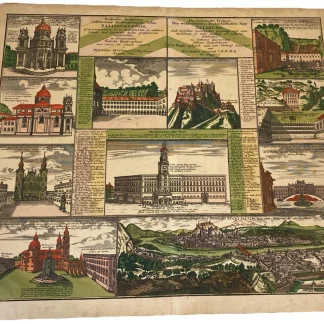
Offered here is an original circa 1740 copperplate etching of Salzburg, Austria, by the renowned German cartographer and engraver Matthaeus Seutter. This richly detailed and vibrantly hand-colored city view was published in Augsburg at the height of Seutter’s career, during his tenure as Imperial Geographer to Charles VI of the Holy Roman Empire.
The composition presents an elegant central prospect of Salzburg, surrounded by multiple architectural and civic views that highlight the city’s Baroque splendor. Identified in German are notable landmarks such as the Benedictine University, Salzburg Cathedral (from both frontal and lateral views), the University Church, the Principal Palace, the Principal Stables, and the Hohensalzburg Fortress. Each structure is depicted with precision and clarity, showcasing Seutter’s dual mastery of cartography and visual storytelling.
This particular example is distinguished by its strong and vivid original hand-coloring, which remains bright and saturated across the entire surface. It is partially mounted to a backing board, likely from an early framing or preservation effort. The print lies flat and stable, with all architectural and textual details fully visible. While many collectors choose to leave such pieces as found, professional restoration could be undertaken to remove the board if desired for conservation or reframing purposes.
*
Original 18th-century copperplate etching published in Augsburg, Germany
*
Artist: Matthaeus Seutter (1678-1757), Imperial Geographer to Charles VI
*
Features detailed views of Salzburg’s most important civic and religious buildings
*
Labeled in period German, with explanatory cartouches and urban layout
*
Strong, original hand-coloring throughout
*
Partially mounted to board; stable and display-ready as-is
*
Restoration required only if full detachment from backing is desired
This is a striking and historically significant work that blends cartographic artistry with early modern urban imagery. It is ideal for collectors of antique prints, 18th-century European history, or decorative architectural views.